Silent Walk at Lake Karla. QueerrRing Ecologies, Volos, March 2026
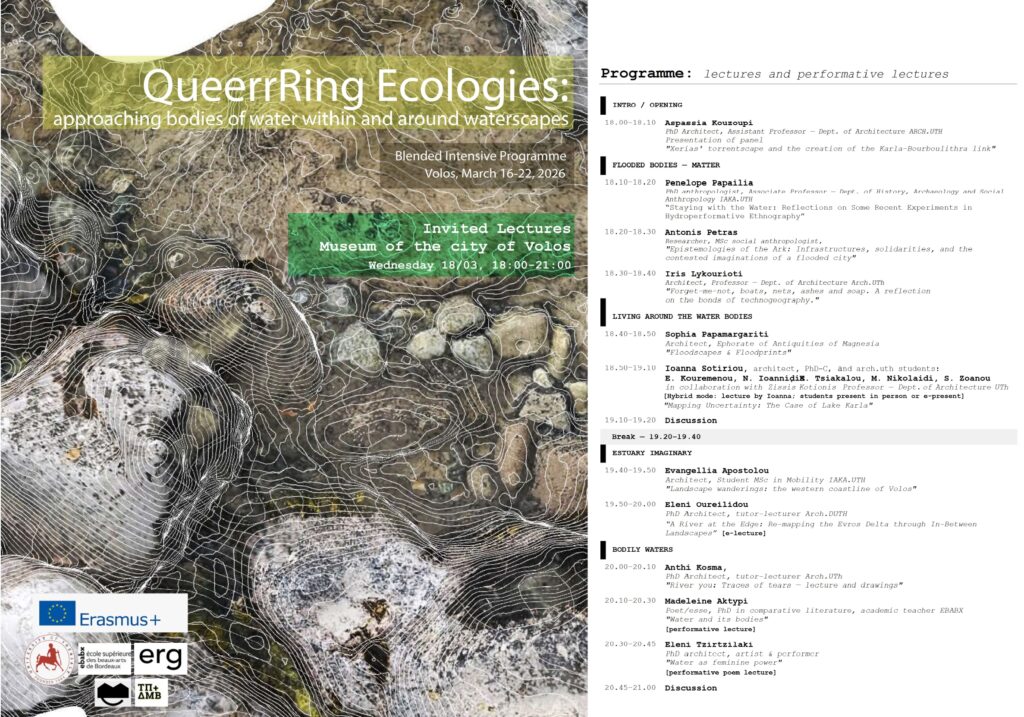
QueerrRing Ecologies: approaching bodies of water within and around waterscapes Blended Intensive Programme, Volos, 16–22 March 2026 Department of Architecture and Department of Culture, Creative Media and Industries, University of Thessaly | École supérieure des Beaux-Arts de Bordeaux (EBABX) | École de Recherche Graphique, Brussels (ERG) | Erasmus+
Participation in the Bodily Waters section of the Invited Lectures at the Museum of the City of Volos (Wednesday 18/3, 18:00–21:00) with a performative poem lecture titled “Water as a feminine power”, and Silent Walk at the historic shore of Lake Karla (Tuesday 17/3).
Silent Walk at Lake Karla / route instructions
I invite you to a silent walk at Lake Karla, or Lake Voiveis (formerly) and in antiquity Voiveis, or Voivias, or Voivi, or Lake Pelasgiotis.
Dress in comfortable clothes, walking shoes, backpack. You will have with you a notebook and a pencil or more and something very small to eat that at the end of the route you would like to offer to the community. It is also essential to have a bottle of water. Your mobile phone will be turned off during the route and you will try to take as few — the necessary — photos along the route so that you can find other ways to record it.
We walk slowly and silently, as much as we can, concentrating on the sounds, the smells, the touch, seeing with the body or through a song while walking on the path. We keep notes-sketches mapping the route. We collect wildflowers and small objects and soil that we consider necessary. At the end of the route in a circle we share our notes, our memories of the route, the food, the flowers, the objects.
Water remains a powerful vehicle for stories even though the containers have been emptied. In Ursula Le Guin’s The Carrier Bag Theory of Fiction (1986) she emphasizes the need to move away from the dominant patriarchal ways of telling stories through the male hero and his weapons and to pay attention to the containers — things that contain something else. In this case, let’s see the lake as a container as well as our own bodies and listen to the stories.
“We are bodies of water,” water that flows from one body to another, from one species to another.